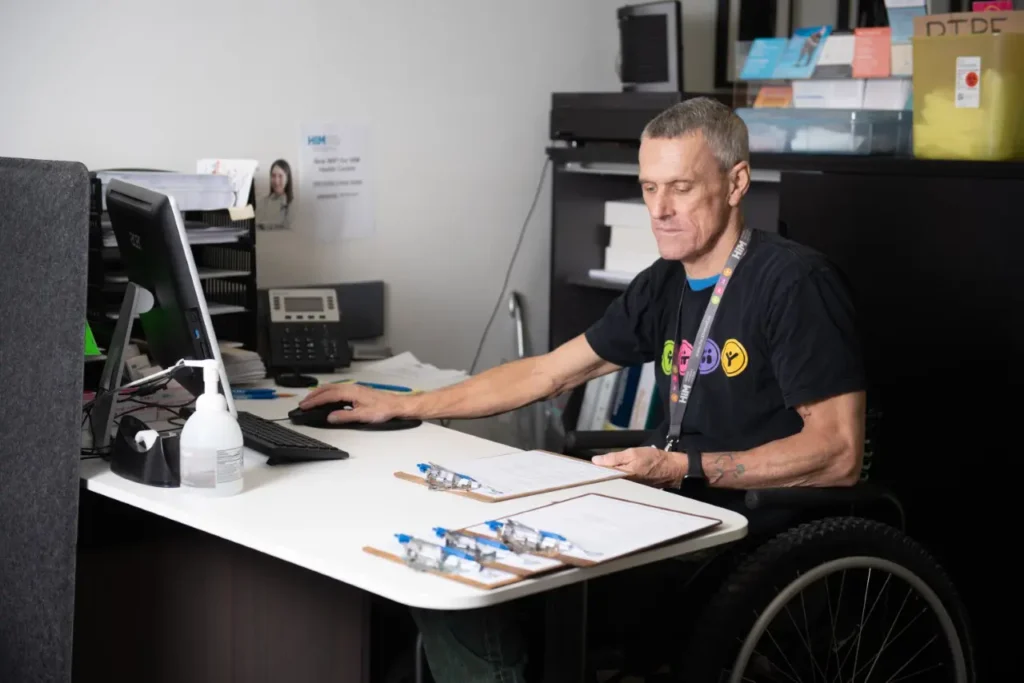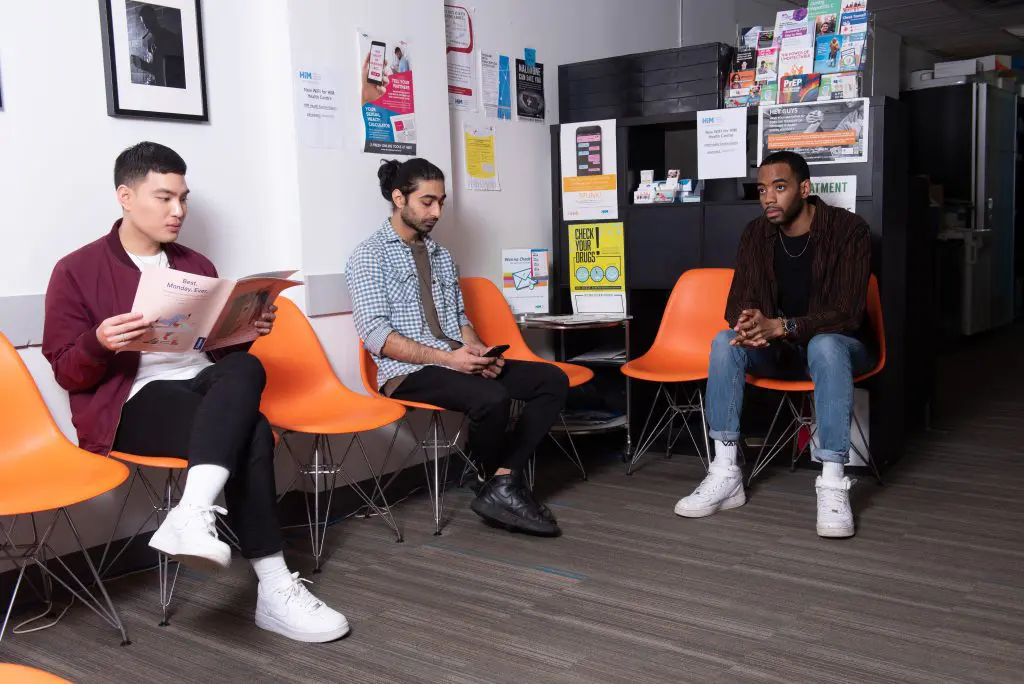
At HIM, we recognize that gay men face unique sexual health issues - that's why we launched two HIM Sexual Health Centres, located at 421 - 1033 Davie Street and 1723 Grant Street in Vancouver.
All services can be accessed by walk-in or by appointment (call us at (604) 488-1001 ext. 223 for both locations during regular office hours, or extension 227 during clinic hours for Davie Street, or (778) 708-3568 during clinic hours for HIM on the Drive).
The HIM Sexual Health Centre on Davie Street is open:
| Monday to Thursday | 4:00 pm - 9:00 pm | ||
| Friday | 11:00 am - 4:00 pm | ||
| Saturday | 10:00 am - 3:00 pm |
The HIM Sexual Health Centre on the Drive is open:
| Monday and Tuesday | 4:00 pm - 8:00 pm |
We offer the Rapid HIV test (your results are delivered in two minutes), the Early test (which detects the virus 10 to 12 days after being infected), the standard HIV test and full STI testing.
We also offer peer support and professional counselling services.
A nurse will ask some background questions about your sexual activities and risk; you can ask questions at any time. The HIV test will be conducted. While you are waiting for your results, the nurse will be available to answer any questions you may have or provide guidance on reducing your risk while having sex.
Rapid HIV test results are available within a few minutes. For standard HIV test and Early HIV test results, you can phone the Bute Street Clinic HIV result line at 604-707-2796. The result line is available Tuesday, Wednesday and Thursday between 11 a.m. and 1 p.m. If you prefer to receive your results in person, simply ask the nurse and schedule a time to return to the HIM Sexual Health Centre.
No. A BC Care Card is not required.
No. You do not need to provide identification for an HIV test at the HIM Sexual Health Centre. Our tests are “non-nominal.” We ask for a word, number or assumed name to identify you anonymously.
Yes. You do not need to be a resident or citizen of Canada to get an HIV test at the HIM Sexual Health Centre.
We offer both walk-in services and appointments. Due to the number of men being tested, we recommend arriving before 8:30p.m. for walk-in services. If you need to get tested after 8:30p.m., please phone us at 604-488-1001, extension 227, to arrange an appointment.
The tests are all conducted by specially trained registered nurses from the BC Centre for Disease Control or Vancouver Coastal Health.
Our expertise is gay men's health. We work with gay men, and other men who have sex with men. If this is not you, we can help you find an HIV testing location with one of our community partners that provide services tailored to your needs.
The HIV tests are free. We do gladly accept donations at the HIM Sexual Health Centre to continue offering services to gay men.
Before you take an HIV test, the nurse will work with you to establish a risk inventory, see which HIV test is best for you and prepare you for your test results. After the test, the nurse will discuss your results and work with you to identify ways to reduce your risk during sexual activities.You are welcome to ask questions at any time.
The Rapid HIV test is administered through a small lancet, which is poked into a fingertip. For the standard HIV and Early HIV tests, a small sample of blood is extracted from the arm, then sent to a medical lab for analysis.
An Early HIV test (also called Ribonucleic Acid test, or RNA test, Nucleic Acid Amplification Testing, or NAAT). This test detects HIV at an earlier stage because, unlike the Rapid and Standard test, it looks for the virus, not the antibodies. It can also detect how much of the virus is present in the blood (“viral load”). The Early HIV test has a much shorter window period—about 10 to 12 days. Basically, this test can detect if someone has contracted HIV (“sero-converted”) sooner than a standard HIV test.
A small sample of blood is extracted from the arm, then sent to a medical lab for analysis.
The test results take about a week. There is not yet a Rapid Early test.
As soon as a person is infected with HIV, the virus duplicates itself very quickly because the body does not yet have antibodies to fight the virus. Between 10 and 12 days after infection, the amount of virus in the body (“viral load”) is detectable with the Early test.
Yes. If blood is collected for other reasons (syphilis screening, for example), the same blood sample can also be used for the Early test. There is usually no need for a second blood sample.
If you have had risky sex or unprotected anal sex more than 8 days ago but less than 4 weeks ago, or you are concerned that you may have contracted HIV recently, you should ask for the Early HIV test. As always , you can discuss your situation with the Registered Nurse at the HIM Sexual Health Centre. He will help you make the right choice.
When HIV enters the body, it reproduces very quickly. Ten to 12 days after infection, the amount of the virus in the bloodstream is very high, even though symptoms might not be present. During this period, a person newly infected with HIV is very infectious to other people. It is estimated that approximately 50% of new infections take place during this period, which is called Acute HIV. During this time, it is very important to work with a doctor to discuss treatment options.
Acute HIV infection takes place two to four weeks after being infected. During the first few weeks, the virus reproduces itself very quickly; virus levels can rise up to 24 times higher than when the body starts to produce antibodies to attack the virus. Once the antibodies engage, the amount of virus drops to a more stable level.
When the virus levels are very high, many newly-infected individuals experience flu-like symptoms. This is sometimes called “sero-conversion illness”.
The symptoms of an acute HIV infection or sero-conversion illness are flu-like, and in some cases, unnoticeable.
Symptoms include fever, rash, fatigue, headache, night sweats, diarrhoea, nausea, vomiting, swollen tonsils and/or other lymph nodes, and joint or muscle ache.
Symptoms might last from one or two weeks. If you feel any of these symptoms and you have had risky sex two to four weeks before, you should take an HIV test.
Sero-conversion is the process in which the body starts making antibodies to fight the HIV virus. This process begins about ten days after being infected.
With an early diagnosis, those newly infected with HIV have more treatment options and are better able to take care of their health.
An early diagnosis is also important to avoid infecting others. Those recently infected with HIV are up to 24 times more infectious because of the high levels of HIV in the bloodstream.
Risky sex is any sexual activity with a risk of getting infected with HIV. Unprotected anal sex with a partner whose status is different than yours is considered highly risky sex. To learn more about risky sex and how to calculate your risk, click here to use our online tools.
The rapid HIV test is a test that looks for HIV antibodies, is done with a finger poke and gives the results in one minute.
The Rapid HIV test has an accuracy of 99.96%. If a test result comes back positive, a second test is administered and sent to a medical laboratory to confirm the result.
The Rapid HIV test is administered through a small lancet, which is poked into a fingertip to draw a small sample of blood.
For about 75% of infected people, the Rapid HIV test will pick up the antibodies four to six weeks after being infected. After three months, close to 100% of infected people will show a positive result. If you test earlier than four weeks, you might not have enough antibodies in your blood to be detected by the test. In that case, you can use the Early test (see Early test).
Yes. The Rapid HIV test is just as accurate as the standard HIV test. The test has been proven accurate through research and extensive medical trials.
The HIM Sexual Health Centre is no longer the only location offering the new Rapid HIV test to the public. Spectrum Health also administers the test, but it is available only for their patients. The IDC at St. Paul's Hospital also offers the Rapid HIV test.
To see a list of other resources for HIV testing in Vancouver, please click here.
Yes, it is possible to do the two tests at the same time when your possible risk event is less than three months ago. Please speak to a nurse at the HIM Sexual Health Centre to discuss your risk factors.
We use the BioLyticalInsti HIV test, which is currently the only Rapid HIV test approved by Health Canada.
Peer support is a way of one person sharing knowledge, experience, and emotional, social or practical help to another. At HIM, we train gay men from our community who volunteer to help other guys by listening and supporting.
Peer supporters working with HIM have had an extensive training in active listening. They are trained in supporting on an equal level, and generally do not ask many questions. As a rule, peer supporters do not provide solutions or try to solve specific problems, but rather offer a chance to reflect and explore options.
In order to meet the demand for these services, we provide six sessions of peer support and/or counselling. If additional sessions are required, please discuss with a peer supporter or counsellor.
A peer support session will take up to an hour and a half. A professional counselling session will take up to one hour.
We offer peer support sessions for free, but gladly accept donations. For our professional counselling, we ask a minimum donation of your hourly wage per session.
All client information is maintained within the strictest confidence. To ensure anonymity, outcome-based measures are assigned a number (not a name).
It is important to note that provincial and federal laws may affect confidentiality issues. Confidentiality may be superseded when the rights of others, particularly the rights of a child or dependent adult, are in need of protection and in cases where maintenance of confidentiality may cause serious harm to the client or to a third party. Reporting occurs where the therapist is required by mandatory reporting law, as follows:
No. A BC Care Card is not required.
Yes. We work with professional counsellors who have at least a post-graduate or masters-level qualification in counselling, psychology or a related area. They have completed a minimum of two years of post-grad counselling work, preferably with gay men, and are usually registered with a professional body.
Yes. The peer supporters are supervised by an experienced clinical psychologist.
Yes, we ask you to sign a service contract. The contract outlines what to expect, your rights to privacy, the scope of confidentiality, your agreement to the service and how HIM responds to complaints. We will send you the contract in an e-mail so you can read it carefully. You must sign it and bring it back to the first session. The peer supporter or counsellor can help you if you have questions about the content.
To make an appointment, please call Hans Bosgoed (604-488-1001, extension 223) or send an email to hans@checkhimout.ca. We will arrange the first session that fits your schedule, and confirm with you by e-mail.
If you have to cancel an appointment, we ask that you provide at least 24 hours notice so we can let our peer supporters and/or counsellors know.
You can get support on a range of issues, including sex and sexuality, coming out, substance use, health issues, relationships, social and community pressures, homophobia, racism, body image, aging, and other concerns.
The intake form is the only form that has your name on it. All subsequent forms will have a code allocated by year, month, day and a sequential numbering for that day. Generally, the peer supporters and counsellors do not take notes. The file is kept on-site in a secure location, and you may access it at any time by making a request in writing to the clinic manager.